Finding a tabletop RPG group is one of the most common requests that comes into game shops, gaming subreddits, and Discord servers across the Midwest. The answer is almost always the same set of resources, in roughly the same order of effectiveness. This guide skips the search phase and gives you the playbook directly.
Why This Is Harder Than It Looks — And Easier Than You Think
Tabletop RPG groups feel hard to find because they're largely invisible to the internet. A weekly D&D group that meets at someone's house on Thursday nights doesn't have a website. It might have a Discord channel, but that's invite-only. It exists through social connections — someone in the group knows someone who knew you, or you met the DM at a game shop event, or you attended the same one-shot at a convention. The community is real and active; it just doesn't announce itself through channels that Google can index.
The solution is to make yourself findable within the actual community infrastructure, rather than searching for groups that have already formed. Here's how.
Step 1: Find Your Local Game Shop and Show Up Consistently
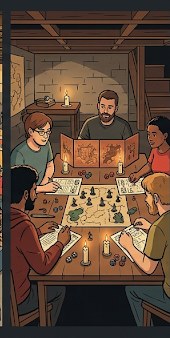
The single most effective thing you can do to find an RPG group in the Midwest is to become a regular at a good local game shop and go to their organized play events. This is not just advice for D&D — it applies to Pathfinder, Call of Cthulhu, Shadowrun, or any system with enough local popularity to generate events.
Here's what organized play looks like in practice: the Dungeon Masters Guild, Wizards of the Coast's official D&D organized play program, runs D&D Adventurers League events at registered shops across the Midwest. These are scheduled, structured sessions where players show up without a fixed group and are seated together to play a published adventure. New players are explicitly welcome. The sessions are designed to be drop-in accessible — you don't need to have been at the last session, you don't need to know the other players, you just show up with a character and play.
Pathfinder Society, Paizo's equivalent program, runs at a similarly broad network of shops. The Paizo event finder at paizo.com lets you search for organized play events by location.
Going to these events two or three times is usually enough to start building the social connections that lead to private group invitations. You meet a DM who's starting a campaign and needs players. You meet another player who knows someone looking for someone for their Thursday group. The infrastructure exists — you just have to show up to access it.
Step 2: Discord Servers by City and Shop
Most active game shops run a Discord server for their community. These servers are not just for official events — they're where regulars coordinate pickup games, announce campaigns looking for players, and discuss games in between sessions. Getting into a shop's Discord and participating in it is the digital equivalent of becoming a regular in the physical space.
Beyond individual shop Discords, there are city-specific and region-specific Discord servers for tabletop gaming communities. Some worth knowing:
- Indianapolis: The Gen Con community has created a broader Indianapolis gaming Discord that's active year-round. Search "Indianapolis tabletop gaming Discord" to find current active servers.
- Columbus: The Origins Game Fair community maintains Discord presence, and individual shops like The Guardtower run community servers.
- Chicago: Multiple Chicago gaming Discord servers exist by neighborhood and by game system. The city's size means there's usually a system-specific server (Chicago D&D, Chicago Pathfinder) worth joining in addition to general gaming servers.
- Twin Cities: The CONvergence community Discord and individual shop Discords serve the Minneapolis-St. Paul gaming community well.
Finding current Discord links: ask at your local game shop, check the shop's social media for Discord invite links, or search Reddit's r/lfg (Looking for Group) subreddit filtered to your city.
Step 3: Reddit's r/lfg and City Subreddits
Reddit's r/lfg is an active community specifically for people looking for tabletop gaming groups. You can post a looking-for-group request specifying your city, system preference, schedule availability, and experience level, and players and GMs looking to fill groups will respond. The response quality varies but the volume is real — this works particularly well for common systems like D&D 5e and Pathfinder 2e.
City subreddits are a secondary option. r/Indianapolis, r/Columbus, r/chicago, and similar subreddits aren't gaming-specific but have members who play games, and a post like "Looking for a D&D group, moved to the city recently" gets genuine responses from people who are plugged into the local community. Less targeted than r/lfg but often more locally specific.
Step 4: Meetup.com
Meetup.com is underestimated as a resource for tabletop RPG group finding because it feels dated. It isn't. Several Midwest cities have active tabletop gaming Meetup groups that run regular game nights:
- Columbus Tabletop Gaming Meetup — one of the larger and more active groups, running regular events at game shops and community spaces
- Chicago Board Game Meetup — covers board games and adjacent hobbies
- Indianapolis Tabletop Gaming — active particularly around Gen Con season but runs year-round
- Twin Cities Tabletop RPG — specifically RPG-focused rather than board gaming
The advantage of Meetup over Discord is that Meetup events are self-contained — you don't need to be an established community member to show up to an event. This makes it particularly good for people who are new to a city and don't yet have connections to the game shop ecosystem.
Step 5: Conventions and One-Shots
If you attend any of the Midwest's major gaming conventions — Gen Con, Origins, Geekway to the West, Gamehole Con — you will be surrounded by people who play exactly what you play. Conventions are extraordinarily good social contexts for finding future gaming partners because the shared interest is completely explicit and the social norms of the convention encourage talking to strangers.
Convention one-shots specifically are worth prioritizing for group-finding purposes. A one-shot RPG event is a self-contained session where you play with three to five other people for three to four hours, then it's over. But the people you played with are people you know now. You have their names. You can connect on Discord or social media. You can ask if they're looking for additional players for an ongoing campaign. Many lasting gaming friendships and groups have started at convention one-shots.
Step 6: Online Play as a Bridge
If local options are moving slowly, Roll20, Foundry VTT, and similar virtual tabletop platforms let you join online games that run on Midwest-compatible schedules. This isn't a permanent substitute for in-person play, but it builds experience, skills, and connections with other players. Some online groups migrate to in-person when members turn out to be geographically close; others stay virtual long-term and that's fine too.
StartPlaying.games is a platform that connects players with professional game masters running paid games online. This is a good option for absolute beginners who want a structured learning experience, though it's not free.
What to Say When You Reach Out
Whether you're posting on Reddit, joining a Discord, or walking up to the organized play table at a game shop, what you say matters. Be specific: name the system(s) you want to play, note your experience level honestly, state your schedule availability, and mention whether you're looking to DM/GM or only to play. Vague "I want to play D&D" posts get fewer responses than specific ones.
Good template: "Looking for a D&D 5e group in the Columbus area. I've played for two years, prefer running players, am available Thursday or Friday evenings and weekend afternoons. Interested in homebrew campaigns or published adventures. Happy to meet up at a game shop or someone's home."
The DM Shortage Is Real
Every tabletop RPG community in the Midwest has more players than Dungeon Masters / Game Masters. If you're willing to learn to DM — even just for a short campaign — you will find players immediately. Running a game is the fastest path to having a regular gaming group. Resources for learning to DM: the D&D Dungeon Master's Guide, the Lazy Dungeon Master series by Sly Flourish, and the Dungeon Coach YouTube channel are all genuinely useful.
Frequently Asked Questions
How long does it typically take to find a regular group?
It varies widely. Someone in Indianapolis who starts going to organized play events at Family Time Games might connect with a DM looking for players within their second or third session. Someone in a smaller Midwest city using only online resources might take two or three months. The most important variable is how actively you're engaging with the local infrastructure — showing up consistently to organized play is the fastest path in most cities. The answer is "faster than you think if you go to the game shop" and "slower than you want if you wait for the community to come to you."
I've never played before. Is it weird to join organized play as a complete beginner?
No. Organized play events — D&D Adventurers League and Pathfinder Society especially — are explicitly designed to accommodate new players. The adventures are accessible to people who have never played. Staff at organized play venues are used to sitting down with new players before a session to walk through character creation and basic rules. Tell whoever is running the event that you're new. They will help you. Nobody started as an experienced player.
What if I want to play a less common system — not D&D or Pathfinder?
Less common systems require more work but aren't impossible in Midwest cities. Call of Cthulhu and Shadowrun both have established player bases in major cities. For very niche systems, online play via Roll20 or Foundry is often the most practical option — the player pool for a specific indie system in a specific city is limited, but the internet has enough players worldwide to reliably find groups. Discord servers for specific game systems are often the best starting point for niche system group-finding.
I moved to a new Midwest city. What's the fastest way to find my gaming community?
Walk into the closest well-reviewed game shop in your new city on an organized play night. Tell them you just moved and you're looking for a regular group. This five-minute conversation, repeated across a few shop visits, typically produces useful introductions within a month. New players in active gaming cities are genuinely welcomed — there's almost always a group that needs one more person, and the organizer at the shop often knows exactly which group that is.
Organized play schedules and community server links change frequently. Always verify current information with individual game shops and through official organized play websites.